Build a Weekly Movement Menu Around Your Real Schedule
A weekly movement menu helps you match enjoyable activities to real openings, choose practical alternatives, and keep a busy or rainy day from derailing your plans.
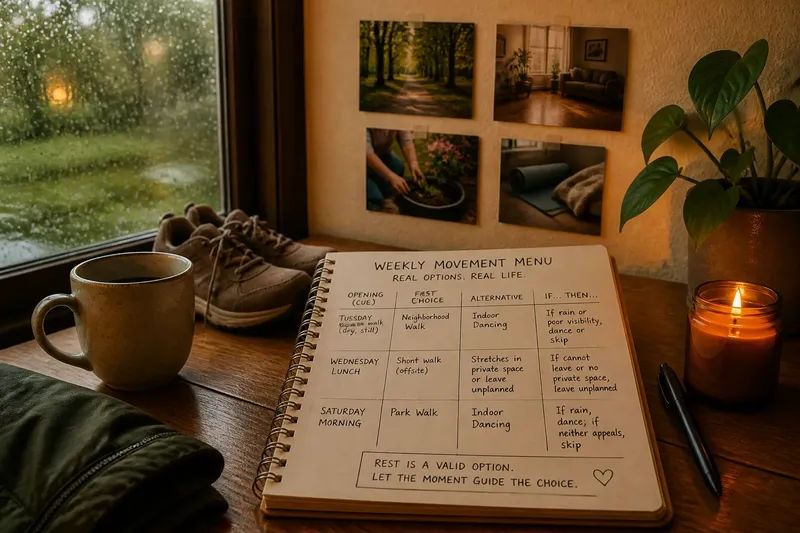
You have twenty minutes before dinner, a pair of walking shoes by the door, and a rainstorm moving in. A weekly movement menu can help you pick an option that suits the moment instead of relying on one activity to work every time.
Unlike a workout schedule, a movement menu is a short list of activities matched to the situations in which they are easiest to choose. It can include walks, dancing, gardening, or gentle stretching. The aim is to make activity easier to select, not to fill every open space.
Choose activities that fit your surroundings
Start with activities you already enjoy or would like to try. Include options that differ in setting and preparation: a familiar neighborhood route, dancing to a playlist at home, gardening, or stretching beside the couch.
Then check what each activity needs. A walk depends on a route and suitable weather; indoor dancing needs enough clear space and music. A community center, public park, or indoor public walkway may offer another setting, depending on local access and rules.
Keep options that feel inviting and practical. If an activity requires equipment or travel you rarely have available, it may not belong on this week’s menu.
Match each option to a real opening
Look at the week ahead and note the circumstances that shape your choices: work shifts, caregiving, travel, weather, and the times you tend to have more or less energy. You are looking for possible openings, not blank spaces that must be filled.
A broad cue can work better than a fixed appointment. “If I get home before dinner” leaves room for a changing schedule. If you use a phone calendar, write “possible walk” rather than turning the idea into an obligation.
Match the activity to the opening. A walk near home might suit a clear evening; a short stretch at home might suit a day with little spare time.
Build a menu with clear choices
For each likely opening, write down a first choice and an alternative that fits the same situation. Make the alternative different enough to address the obstacle, not just a smaller version of the original plan.
- Check whether the evening route is usable in the weather; if it is dry and comfortable, choose the neighborhood walk, and if rain or poor visibility makes it unsuitable, choose indoor dancing or skip that opening.
- Check whether you can leave your workplace during lunch; if you can, choose a nearby stroll, and if you cannot, choose a few stretches in a suitable private space or leave lunch unplanned.
- Check whether a friend is free for a walk; if both schedules line up, meet on a familiar route, and if not, choose a solo route or another activity you enjoy.
- Check whether you have enough energy for the activity you listed; if you do, choose it, and if you feel tired, try gentle stretching or leave the opening unused.
- Check whether a park or garden is accessible that day; if it is, choose a relaxed walk or gardening, and if it is closed or inconvenient, choose an indoor option.
- Check whether your chosen activity still appeals when the opening arrives; if it does, go ahead, and if it does not, choose another menu option or let the moment pass.
Each choice has an observable cue and a next action. That makes the menu useful without requiring you to predict exactly how the week will unfold.
How should a weekly movement menu handle changes?
What should I do when I miss an opening?
Let the opening pass rather than treating it as unfinished work. Check the remaining options and choose one only if it still fits your schedule and interest.
How many activities belong on the menu?
Keep enough options to cover the settings and circumstances you expect, but few enough to scan quickly. If choosing starts to feel like another task, remove activities that are hard to access or no longer appeal.
Can a movement menu include rest?
Yes. An open day is a valid choice, especially when your schedule is full or you need rest. Do not move every unused idea to another day as though it were a debt.
How can I tell when an option needs replacing?
Notice whether the same obstacle keeps appearing, such as an inconvenient route, a class that is difficult to reach, or an activity you no longer enjoy. Change the option to address that obstacle rather than treating it as a personal failure.
Work through one week with actual choices
Say your starting inputs are an open Tuesday evening, a Wednesday lunch break you cannot leave, and a Saturday morning that may bring rain. You enjoy walking and indoor dancing, and you have no need to schedule activity every day.
First, put “possible neighborhood walk or indoor dancing” beside Tuesday evening. When Tuesday arrives, you find the weather dry and still want to walk, so you take the familiar route. The observable result is that one menu option fit the opening; there is no need to add another activity to compensate.
Next, leave Wednesday lunch unfilled because you cannot leave work and have no suitable private space for stretching. The decision is to keep that opening free, rather than forcing an inconvenient alternative. For Saturday, list a park walk if the weather is suitable and indoor dancing if it rains. If rain arrives, you can choose dancing; if neither option appeals, you can leave the opening unused.
The tradeoff is clear: the menu offers choices without promising that every listed activity will happen. It also keeps an unused idea from becoming a backlog.
Revise the menu using what you noticed
At the end of the week, notice which options were easy to choose and which depended on conditions you could not count on. If the park was inconvenient, replace it with a route closer to home. If dancing felt better with company, keep it as a social option while retaining a solo alternative.
A weekly movement menu works best when it reflects the life you actually have. Keep the choices that still appeal, remove the ones that repeatedly fail to fit, and leave room for an ordinary day to remain open.