Before the Step Counter: A Short History of Counting Movement
The history of counting movement runs from handwritten walking records to phone dashboards, helping you see what each measure captures and leaves out.
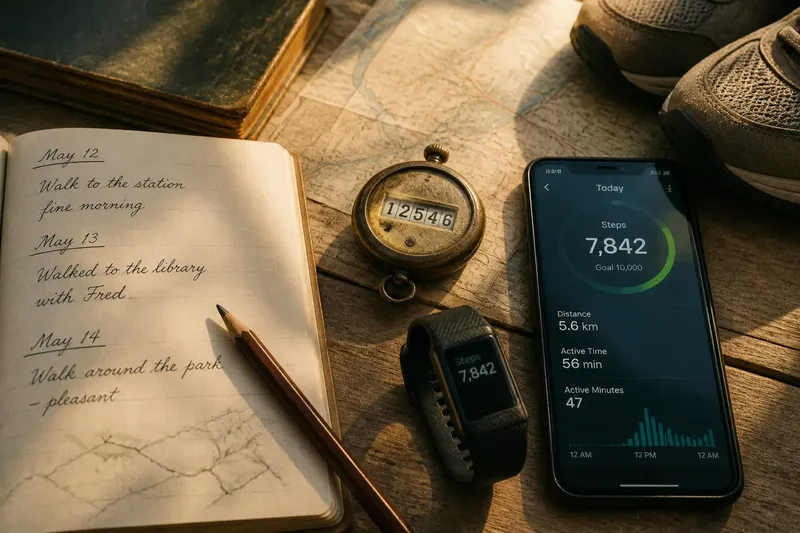
A handwritten walking club log might record a route and the date, while a phone today can display steps from the same outing. The history of counting movement is not a smooth march toward a perfect number. It is a story of changing tools and questions: what counts as activity, and what can a record tell us?
There is no single starting point for recording movement. People have long written down journeys, exercise, and daily tasks for different reasons. Looking at those records alongside later devices shows how a walk shifted from an event to something that could also be tallied.
Walking records described routes before they counted steps
Travel accounts, diaries, and personal schedules often describe movement through destinations and events: someone left home, reached a town, or walked to a meeting. These records tell a reader where a person went and why. Unless they include a stated distance or duration, they do not give a count of each step.
By the nineteenth century, walking clubs and guidebooks offered another way to describe a walk. Club records could preserve routes and outings; guidebooks could describe paths and destinations for other walkers. These are concrete historical anchors, but they do not establish that everyone recorded walking in the same way. Their purpose was often to document a journey or help plan one, not to tally all movement in a day.
A diary entry such as “walked to the station” preserves an event. A route description adds where the walk went. Neither automatically answers how long the person walked or how many steps they took.
When reading an older account, separate what it states from what it leaves uncounted.
Exercise logs made the walk an intentional activity
As organized recreation and physical education became more visible in the nineteenth and twentieth centuries, some people began to record exercise as a distinct activity rather than simply a journey from one place to another. Logs could note a walk, its route, its duration, or a person’s impression of effort. The exact details varied by person and purpose, so no single format represents every walker or period.
This was a change in framing, not the invention of walking. A commute and an exercise walk might cover similar ground, yet a log could treat one as travel and the other as deliberate practice. Recording the walk made it easier to remember and compare outings, while still depending on what the writer chose to note.
- If a log names only a destination, it preserves the purpose or endpoint; if you need to compare how long outings lasted, add a duration rather than infer one.
- If a log records time but not a route, it preserves duration; if location matters, write down the route or destination as well.
- If a log describes effort in words, it preserves the writer’s impression; if you need a count, use a suitable counting tool and treat its result as a separate kind of record.
Choose a record for the detail you actually want to remember.
Pedometers turned steps into a visible total
Mechanical pedometers were developed in earlier centuries, and by the twentieth century step counters were available as personal devices. Worn or carried on the body, a pedometer used motion to register steps and display a running total. This let a person count walking across separate parts of a day, not only during one planned outing.
The change was significant: errands and other everyday walks could appear in the same total as an exercise walk. But a pedometer’s number depends on how the device detects motion and how it is worn or carried. It is a record of detected steps, not a full description of movement or effort.
Say you carry a pedometer on a day with a trip to the grocery store and several trips around the house. At day’s end, its total may make those scattered walks visible together; it will not tell you which trip mattered most or what you carried.
Phones and wearables combined movement records
Later, phones and wearable devices brought motion sensors and software into one personal record. Depending on the device and settings, a screen may show steps, estimated distance, active time, or periods of inactivity. This dashboard format gathers categories that earlier records often kept separate or did not count at all.
Each category has limits. Steps represent detected walking motion. Distance may be calculated from a route or other sensor data. “Active minutes” is a device-defined label for time classified as activity; it is not interchangeable with steps. Cycling, swimming, strength exercise, carrying groceries, and dancing may appear differently or be missed, depending on the device.
If a dashboard leaves you feeling judged by a number, you can ignore that display, choose a less intrusive record, or stop recording. A device’s category is a tool’s interpretation, not a verdict on the day.
What can movement records tell you?
Do step counts represent all movement?
No. They represent detected steps, so activities such as cycling, swimming, and strength exercise may not translate into a step total. Use a separate note or an activity category if that context matters to you.
Why might two step counters disagree?
Devices can use different sensors and rules for recognizing a step, and placement or carrying habits can affect their records. Treat each device as its own recording method instead of assuming that separate displays are directly comparable.
How do steps differ from active minutes?
Steps count detected walking movements, while active minutes reflect a device’s classification of time spent moving at a chosen level. Check the device’s description to understand its label, and do not treat the two categories as equivalent.
Can a handwritten log still be useful?
Yes. A note such as “walked to the library with a friend” preserves destination and company, details a step total does not provide. Choose a written note when that context matters more than a count.
A simple comparison shows how records frame a day
Imagine Jordan wants to understand why an ordinary week looks different in a diary and on a phone. Jordan starts with a notebook, a familiar walk to the bus stop, and a phone that already records steps. The aim is to compare what each method describes, not to reach a target.
- On Monday, Jordan writes “walked to the bus stop.” The result is a record of the destination, but not duration or steps.
- On Tuesday, Jordan times the same walk with a phone clock and writes the duration beside the route. The record now includes time, but still does not count steps.
- On Wednesday, Jordan carries the phone as usual and notes its step display at day’s end. The result includes a device-generated total, but does not separate the bus-stop walk from other movement.
- On Thursday, Jordan cycles to a nearby errand and writes that in the notebook. The entry preserves cycling even if the step total does not represent the ride clearly.
- On Friday, Jordan compares the entries. The notebook explains destinations and activity types; the phone offers a step total; neither record answers every question.
- Jordan decides to keep the notebook note for context and glance at the phone only when a broad step record is useful. If the display feels distracting, Jordan can stop checking it and keep the written account instead.
This comparison shows the tradeoff: a count can gather movement into a visible total, while a note can preserve what the movement meant in context.
Movement counting history is a history of choices
Across travel accounts, exercise logs, mechanical pedometers, and phone dashboards, each method made different details easier to record. A diary could preserve an event, a log could describe an intentional walk, a pedometer could total detected steps, and software could organize selected signals into categories.
The history of counting movement is useful because it reminds us to ask what a record actually represents. Before relying on a number, check whether it counts steps, time, or a device-defined category. If you want to remember the route, company, or purpose, a short written note may tell you more.